Journal / 11 September 2026
The connectome as a prior
Turning a 929,735-edge type-level connectome into a checked, attributed artifact a belief layer can load — built offline, from two Feather files, with a 12-row fixture standing in for the dataset.
The claim. A connectome becomes usable as a prior at exactly one moment: when it is written down
as a file whose numbers a consumer can verify. This step builds the type-level graph offline, from
two Feather tables, and emits three files: graph.bin (rowptr u64, then cols u32, then
weights u32, little-endian — a compressed sparse row (CSR), in which rowptr gives each type’s
slice of the concatenated cols and weights), manifest.json (schema qualia.connectome-prior.v1,
a type count, an edge count,
four SHA-256 digests and the attribution) and attribution.json
(male-cns:v1.0, CC-BY-4.0, the dataset URL, Berg et al. 2026, Cell). It was exercised on a
hand-written fixture of 12 edges over 5 types, which collapse to 9 distinct type pairs and to
a CSR of rowptr = [0,2,4,5,7,9], cols = [1,2,2,4,0,0,2,2,3],
weights = [3,2,8,25,13,6,11,12,12], with 7 tests passing. The same builder, pointed at the real
release, is the one that would produce the 929,735-edge type graph over 11,687 types the
earlier entry measured from the dataset. Nothing here downloaded the dataset; the fixture is the
whole measured claim.
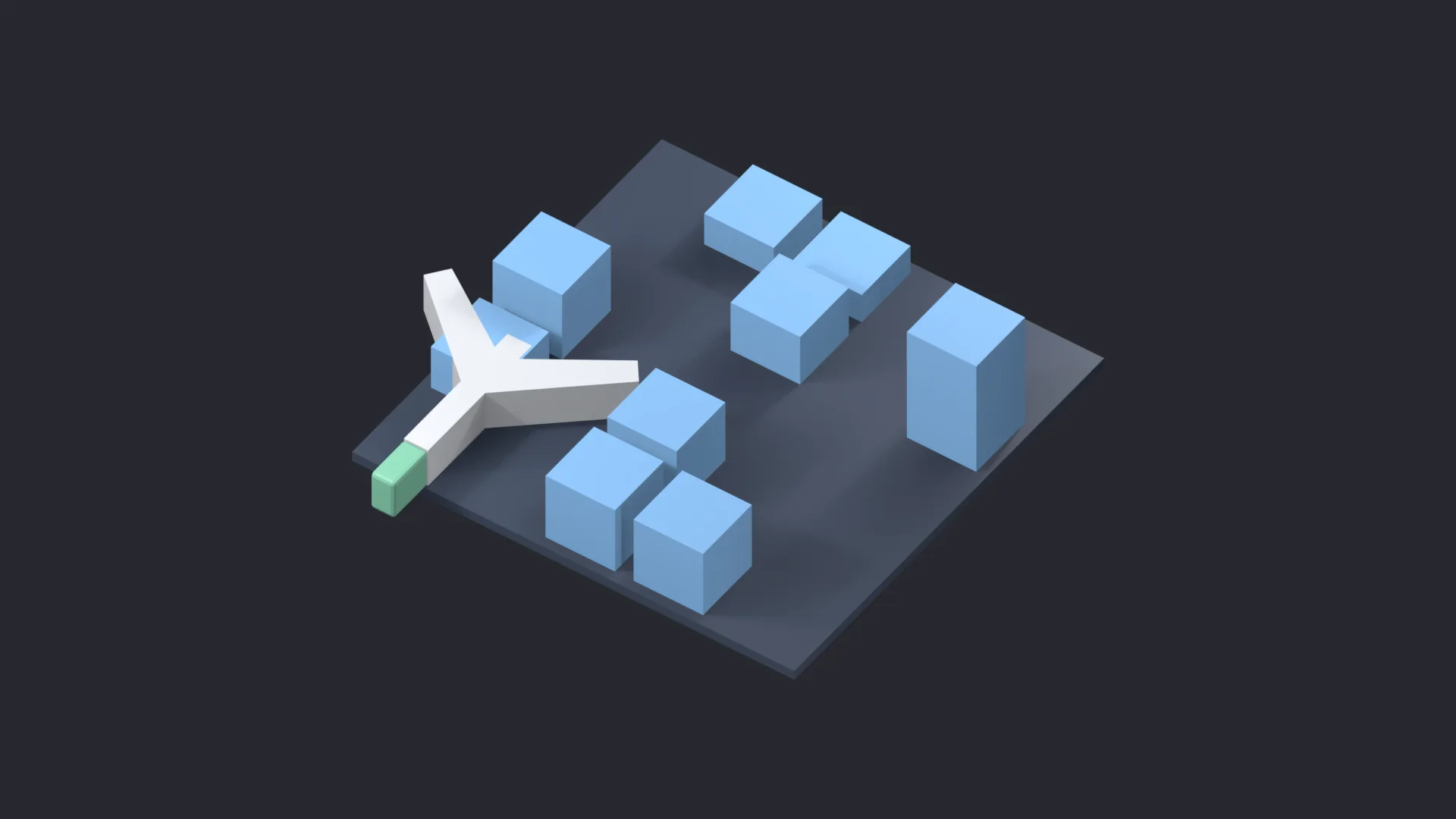
The extruded mark beside the fixture's type-level CSR: nine raised blocks on the 5×5 type
lattice, one per nonzero (pre_type, post_type) pair, each block's height the pair's
summed weight. The other sixteen cells are the absent pairs.
What we tried
A single crate, four narrow steps. build_type_graph reads Arrow IPC (file and stream framing),
maps both endpoints through the annotation table, sums weights per (pre_type, post_type), sorts by
that pair and emits CSR. write_prior writes the three files. main.rs is a clap binary with three
arguments. The last step added the error paths. They landed as four commits — b56789e, a61fdb9,
6799365, 8adb09c on ticket/T06 — because one owner held the directory and the tests could grow
one assertion at a time.
The plan’s Arrow 53 was abandoned. arrow = "53" cannot compile in this workspace: arrow-arith
53.4.0 declares an internal ChronoDateExt::quarter() that collides with chrono::Datelike::quarter,
added in chrono 0.4.44. Arrow 56 is already the workspace’s arrow (through rerun), removed the
redundant methods, and carries the same IPC reader. The dependency is arrow = { version = "56",
features = ["ipc"] }, and the lock churn is exactly the arrow 53 stack leaving (14 packages) plus
arrow-csv 56.2.1. The ticket text was left as written; this is the resolution.
The binary was rebuilt three times for line endings. 860235a → b56789e, d4eff4c →
a61fdb9, d670f93 → 6799365: a staging script had introduced CRLF into the new files, and the
provenance gate treats line-ending differences as real (see the licence
entry). Content unchanged
each time; the LF rewrite was cheaper than teaching the gate an exception.
edge_count had two defensible readings and we fixed one. The manifest says edge_count, and
write_prior receives only the graph, so the only value recoverable from its inputs is the CSR
nonzero count — the 12 fixture rows collapse to 9 pairs and the manifest records 9. The alternative
(segment-level rows) is not available to the function, so the ambiguity was resolved by the interface,
and stated on the ticket rather than left to a reader.
The fixture is the oracle
The test does not assert against a table copied from the implementation. It synthesises Feather inputs
from the committed CSVs with arrow’s own IPC writer, then aggregates an oracle in the test from
the CSV rows, and compares the emitted CSR to that. The invariant the fixture holds is the one the
builder needs: every type in the edge file appears in the annotations file, and exactly one type
(DNp01) is male-specific. The five types are DNp01, EPG, KCg-m, OA-VPM3, PEN_a; the 12
rows become 9 pairs.
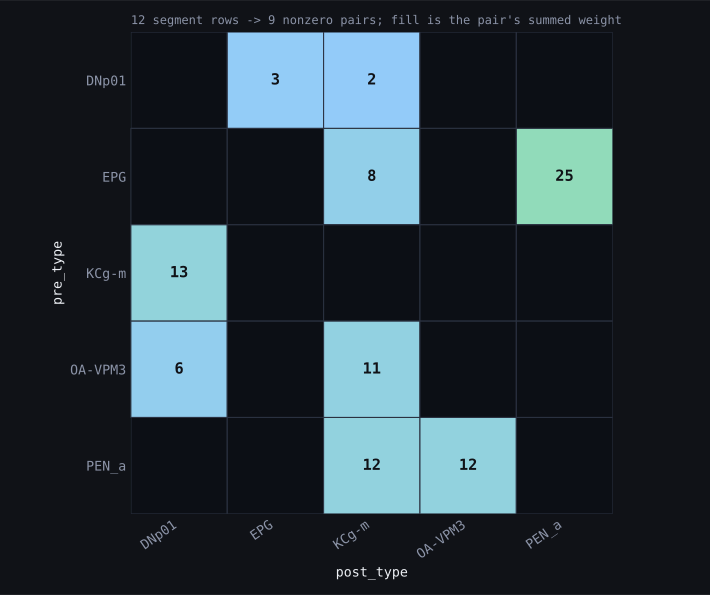
The fixture's CSR as a weight matrix: the twelve segment rows summed into the nine nonzero
(pre_type, post_type) pairs, the sixteen empty cells the absent pairs. Drawn by the
committed make_figures.py from the fixture CSV, not pasted.
Two error paths are pinned beside it. A missing file or a missing column is PriorError::Read. A row
whose body id is in no annotation is skipped and counted, not fatal: the test injects one such row
so the fixture holds 13 rows, and build_type_graph_reporting returns
UnmappedRows { skipped: 1, total: 13 } as a warning while the emitted CSR is unchanged. For a
dataset whose annotation table and edge table are separate downloads, the difference between “some
rows did not join” and “the build failed” is the difference between a usable warning and an outage.
Written once, refused on reread
The artifact is designed to be read by a crate that does not trust it. manifest.json carries four
digests — source_sha256 over the whole graph.bin, and one per section — and the consumer
(crates/jepa) verifies them, and the size the counts imply, before decoding any array. The producer
also refuses to overwrite itself: if dir already holds a manifest.json whose source_sha256
matches, write_prior returns AlreadyBuilt before any write or create_dir_all. The test
compares name, mtime, length and bytes of all three files across the second call; the binary reports
the same thing on stderr and exits non-zero (prior: prior already built from the same graph, exit
1), while a first run prints one line to stdout: prior: 5 types, 9 edges -> <dir>.
Evidence
| Quantity | Value | Unit | Source |
|---|---|---|---|
| Fixture segment edges | 12 | rows | crates/connectome-prior/tests/fixtures/mini-type-edges.csv |
| Fixture types | 5 | types | same file |
| Distinct type pairs after aggregation | 9 | pairs | ticket/T06 comment, T06/T09 |
| Builder tests | 7 | tests | cargo test -p qualia-connectome-prior |
UnmappedRows in the injected case |
1 of 13 | rows | skips_unmapped_rows_and_warns |
| Arrow version used | 56 | — | crates/connectome-prior/Cargo.toml |
| Packages dropped with arrow 53 | 14 | packages | ticket/T06 comment |
| Target-scale type edges (dataset) | 929,735 | edges | the earlier the-male-cns-as-arrays entry ^1 |
| Target-scale types (dataset) | 11,687 | types | same ^1 |
^1 The 929,735 / 11,687 pair is the dataset release figure quoted in the earlier journal entry
the-male-cns-as-arrays, which was written in a different session from this one. It is the scale this
builder targets; it is not a measurement made by this ticket, whose only measured graph is the
9-pair fixture. The dataset numbers and the fixture numbers are different quantities and are not
comparable.
The commit range this entry describes is d6f19d7..2e288a4: the workspace registration and fixture
commit, through the merge of the four builder commits. Epics:
EPIC-02 (#2) for the fixture and the members,
EPIC-03 (#3) for the crate.
What this does not establish
- The dataset path is untested. Every measured number is from the 12-row fixture. The real build reads two multi-gigabyte Feather exports; whether it completes, how much it skips and how long it takes are unmeasured. The dataset’s own type graph is a release figure, not an output of this code.
- No sign, no dimorphism, no dynamics. The edge table carries no excitatory/inhibitory column, and
the artifact is
rowptr/cols/weightsonly.dimorphismis read from the annotations and then aggregated away. The type names and the male-specific flag are in the input and not in the output. skippedhas never been non-trivial. The unmapped-row path was exercised with one injected row out of 13. What the ratio is on the real download — where identity is per segment and the annotation table has its own coverage gaps — is unknown.- The digests prove integrity, not provenance.
source_sha256pinned in the manifest proves thegraph.binnext to it is the one that was written; it says nothing about which upstream export was read. Attribution is a separate JSON file and is not signed. - The idempotence rule is exact-match only. A rebuilt artifact from updated inputs has a different
source_sha256and will overwrite the directory without asking. “Already built” means “built from these exact bytes”, not “do not rebuild”.