Journal / 10 September 2026 / mage-006
The load in flight, and the shape Triton uses
The matrix multiply stopped waiting on its own tile loads — 80.00 to 68.62 µs — and the layer norm was rebuilt in the shape Triton's kernel emits — 10.05 to 8.97 µs. Both changes are the same change: more independent loads in flight.
The three spots are the two rewrites and the drift they have to beat, opacity set by each change's share of the kernel time it started from.
Field: Paper Shaders mesh gradient (Apache-2.0), palette and weights from this post.The claim. Both kernels lost the same thing, and neither lost it to arithmetic: neither could keep a second memory request in flight. The matrix multiply copied each K tile into shared memory, synchronized the block, and only then multiplied, so no copy was outstanding while the multiply-adds ran; two buffers and an asynchronous copy took it from $80.00$ to $68.62\ \mu s$ of GPU kernel time. Layer normalization had nothing to overlap — it read its row twice, at 39 registers a thread — and rebuilt in the shape Triton’s generated code uses it went from $10.05$ to $8.97\ \mu s$. The multiply now beats every Triton matrix-multiply capture on these shapes and still trails the cuBLAS call; the layer norm is $7\text{–}10\%$ behind Triton and that gap is open.
The multiply was waiting on a copy that had not been issued
A block owns a $64 \times 64$ tile of $C$ — $16 \times 16 = 256$ threads holding $4 \times 4$ outputs each — fed from 33792 bytes of shared memory holding a transposed $A$ and a $B$. The kernel that entered this stage filled it in the worst order: copy the tile, hit the barrier, then multiply. Nothing moved while the multiply-adds ran, and nothing multiplied while the next tile moved.

Schematic, not a measurement: the same block tile and the same 33792 bytes of shared memory, filled two ways. On the left copy, barrier and multiply-adds strictly alternate; on the right the next tile's copy occupies the same interval as this tile's multiply-adds. Download the SVG.
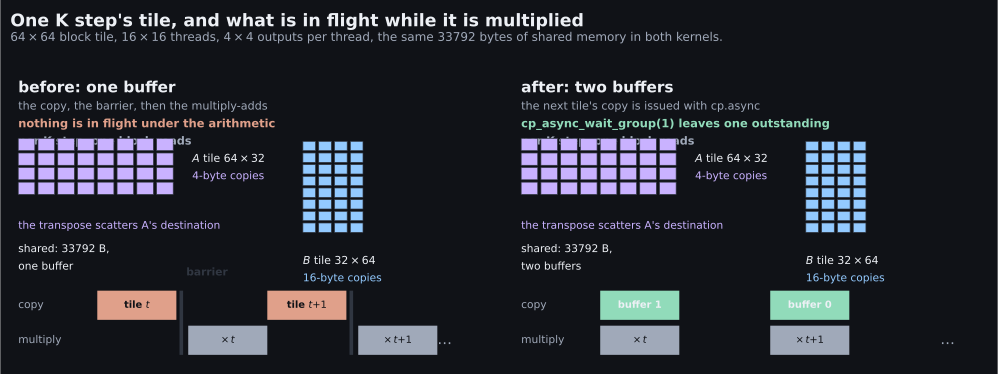
The pipeline keeps the footprint and splits it: two buffers, one $64 \times 32$ $A$ tile and one
$32 \times 64$ $B$ tile each, copies issued with cp.async and the wait deferred by
cp_async_wait_group(1), so one copy group may still be outstanding. The $A$ tile needs
four-byte copies because the transpose scatters its destination in shared memory; $B$ needs none
of that and takes sixteen-byte copies.
The first pipeline was wrong, and the harness would have reported a 69 µs “win” from it: the buffer offsets were computed in the wrong units, so one buffer was read from inside the other, and the last tile consumed $\text{tiles} \bmod 2$ instead of $(\text{tiles}-1) \bmod 2$. The correctness check caught both. After the fixes the $1024^3$ product matches the PyTorch FP32 reference with a maximum absolute error of $0.0$, and the kernel measures 68.62 µs against 80.00 — stable at 68.35, 68.60, 68.68 and 68.62 across four sessions. The second buffer costs registers: 96 a thread instead of 56, spent keeping both buffers’ addresses live.
The layer norm was not waiting on anything; its shape was wrong
Layer normalization reduces each row twice, once for the mean and once around it:
\[\mu_i=\frac{1}{d}\sum_{j=1}^{d}x_{ij}, \qquad \sigma_i^2=\frac{1}{d}\sum_{j=1}^{d}\left(x_{ij}-\mu_i\right)^2 .\]Nothing here waits on a copy, so the question was why Triton’s kernel is faster at the same
shape. Counters are unavailable on this host, so the answer came out of Triton’s generated
code: its norm_kernel was compiled offline for sm_89 through the ASTSource/GPUTarget
path — no GPU, no execution — and the PTX and cubin censused.
| Property | Triton norm_kernel |
committed layer_norm_pair |
|---|---|---|
| Grid × block | 4096 × 128, one block per row | 1024 × 256, two warps per row |
| Registers / shared | 31 / 16 bytes | 39 / 64 bytes |
| Loads | 24 scalar ld.global.b32, covering x, scale and bias |
12 quad loads |
| Stores | 8 scalar | quad |
| Passes over x | one, held in registers | two |
| Barriers | 3 | 1 |
The lesson is not vectorisation: Triton’s loads are scalar 32-bit, not the 128-bit quads the Rust kernel already used. With $d = 768$ and one block of 128 threads per row, each thread owns $\tfrac{768}{128} = 6$ values of the row in eight register slots — a quad and a masked quad — so the row is read once and both sums come from registers.
layer_norm_row takes that shape: 4096 blocks of 128 threads, one per row; four warps reducing
with shuffle_down and meeting once in eight floats of shared memory behind one barrier;
the output written from the registers that already hold it; and rsqrt_approx_f32 where Triton
emits $1.0/\sqrt{\sigma^2+\epsilon}$ through sqrt_rn_f32 — one instruction, about $10^{-7}$
relative error, inside the $10^{-4}$ tolerance. Wider rows keep the two-warp kernel and widths
that are not a multiple of four keep the scalar one. It measures 8.97 µs against 10.05, and
8.85 µs in the three other sessions that measured it, against Triton’s 7.99, 8.06, 8.07, 8.09,
8.10 and 8.32 µs. The register profile now matches and the single pass is the same, but the
kernel is still $7\text{–}10\%$ behind and what remains cannot be attributed on this host; it is
tracked in mage issue #54.
Evidence
Kernel time is the sum of captured kernel durations over 100 iterations, from one Nsight Systems capture per implementation and operation; spans are the mean of 300 warmed CUDA-event samples in three rounds. Every output was checked against the PyTorch FP32 reference before any timing was kept. Microseconds throughout.
| Stage | Matrix multiplication | LayerNorm | Retained in |
|---|---|---|---|
| original arrangement | 343.99 | 18.64 | mage-001 |
| first rewrite (PR #42) | 141.70 | 11.03 | mage-002, mage-003 |
| second rewrite (PR #43 / #44) | 80.00 | 10.05 | mage-003 |
| third rewrite (PR #49 / #52) | 68.62 | 8.97 | mage-006 |
The LayerNorm value at PR #42 is the warp kernel measured in a later session than its own — the
mage-002 namespace records 11.09 µs for the same kernel — and the value at the third rewrite is
8.85 µs in the three other sessions that measured it. The spans around the call move with the
last two stages: 82.60 → 74.09 µs for the matrix multiply and 12.91 → 12.26 µs for layer
normalization.
The three untouched operations bound how much of that movement could be drift: between the
mage-003 and mage-006 namespaces their kernel time moves by 1.6%, 1.9% and 0.0% — 10.97 →
11.15, 80.07 → 81.60 and 10.33 → 10.33 µs. The library side is not that steady, which is why no
baseline is compared across namespaces: the PyTorch neighbor-aggregation kernel moves from 67.33
to 120.93 µs between the same two.
What was tried and not kept
Single development measurements, not retained evidence. The first two fixed the block size — 128 threads holding a quad plus a masked tail slot is kept because both alternatives measured slower — and the last three read the row once without changing the launch shape.
- 96 threads per row: 8.99 µs of kernel time, against 8.09 for Triton in the same session; 192 threads per row, one quad each: 9.11 µs against 8.85 for the retained 128-thread build.
- Four warps per row on an uneven split: 13.3–13.7 µs of event span against 12.67; a row staged in shared memory: 14.3 µs against the same 12.67; a row held in registers on the two-warp split: 13.88 µs against the same 12.67.
What the numbers do not establish
- The library call is still ahead of the multiply: 68.62 µs against 44.03–66.22 for the cuBLAS call behind PyTorch across the four namespaces, so the margin is small and session-dependent.
- Triton’s matrix multiply is not stable between sessions: 71.94, 79.84, 86.95, 90.09 and 100.80 µs across captures, where the Rust kernel moved only within 68.35–68.68. The layer-normalization control from the same session returned 8.32 µs, inside Triton’s 7.99–8.32 band, so that comparison is usable and no matrix-multiply ranking follows from one pairing.
- The layer-normalization gap is open: 8.85–8.97 µs against 7.99–8.32, $7\text{–}10\%$, with the register profile matched and the same single-pass structure. Nsight Compute is unavailable, so both occupancy arguments rest on the resource request each kernel makes, not on counters.
- One capture per case, one workstation: kernel time carries no interval of its own, and the two views come from separate runs, so subtracting one from the other does not isolate host overhead. Five fixed FP32 shapes, one WSL2 host, an RTX 4090; compilation, transfers, tile tails, lower precision and backward passes are excluded.
The field note carries every figure and table; the technical record has the method and the reproduction commands.