Journal / 11 September 2026
The ladder
The neuro-symbolic seam as one number — squared Mahalanobis distance from the predictor's mean, computed with the JEPA crate's own routine — plus a rule table, and a healing ladder that is still only a specification.
The claim. The seam between the neural and symbolic halves is a single measured number: how far
the observed latent sits from what the predictor expected. crates/braid/src/drift.rs computes
qualia_jepa::diagonal_mahalanobis_squared(latent, predicted_mean, precision) with
precision = exp(-log_variance) — the crate’s squared distance, the number a threshold compares —
and returns DriftReport { mahalanobis, sample_count }. Identity prediction is exactly 0.0; ragged,
empty or non-finite inputs return 0.0 with sample_count 0, the mute pair, so a malformed sample
fires no rule. Around it, the rule table exists as data: four default_rules() in a fixed order, the
first of which lowers coupling by a factor of 0.90 on a failed mission. qualia-braid finished at
17 tests on the board for the drift half and 24 tests with the rules. The ladder those
thresholds describe — recalibrate, roll back, observe-only, safe stop — is not in the tree yet;
what has landed is the measurement and the rules, and that distinction is the point of this entry.

The extruded mark beside the healing ladder's four bands as four concentric rings, the gaps between them at squared Mahalanobis 3, 5 and 8. The outermost band is open-ended: the ladder's thresholds are the plan's specification, not a measurement.
What we tried
The measurement was not re-derived. crates/jepa already exports the Mahalanobis routine the
model’s own NLL uses, so the braid calls it instead of writing a second one. The reference tree has no
braid crate at all, so drift.rs has no counterpart to match and the ticket text is the whole
interface; reusing the only existing math for the same quantity was the one decision available.
Three inputs had to be made mute, not loud. The ticket says a length mismatch returns
sample_count == 0 and that observe treats it as “no opinion”. Review found the rest of the family:
non-finite latents or means, a non-finite log-variance — which would otherwise reach exp — and a
precision that is not real. All of them return the mute pair. The point is that the drift path cannot
panic a running stack on a bad sample; a rule layer that fires on garbage is worse than one that
abstains.
The first rule table had a rule that cannot fire, and that is recorded, not hidden. The plan’s
default_rules() includes DriftAbove { threshold: 3.0 } → EnterObserveOnly. The braid’s frozen
BraidEvent vocabulary is a closed set of six variants plus Unknown, and no variant carries a drift
measurement; T34 shipped DriftReport without adding a drift event. So DriftAbove is contract data
that fires against no event evaluate can be handed today. The ticket’s text was left as written and
the gap was pinned by a test — the_drift_rule_fires_on_no_event_the_braid_carries_yet — rather than
inventing a variant the ticket does not name. The drift reaches the healing ladder directly, when the
ladder exists.
Falsification, not just green. For the rules, two deliberate mutations (swap the first two default
rules; ignore the matched outcome) were built and both were caught, EXIT=101; reverted, the suite
went green again. For the drift tests, they were written before drift.rs existed and failed with
E0432: unresolved import qualia_braid::drift.
The ladder is the ticket’s contract, not a measurement
The epic’s Step 35 fixes the escalation, and it is worth writing down exactly because none of it runs yet — these are thresholds from the plan, and no code in the tree compares a drift to them:
| Condition | Step |
|---|---|
mahalanobis <= 3.0 |
none |
mahalanobis <= 5.0 |
recalibrate (through the registry’s calibration gate) |
mahalanobis <= 8.0 |
roll back to the previous generation |
mahalanobis > 8.0, or attempts >= 3 |
observe-only |
| observe-only held 10 s with drift still above 8.0 | request a safe stop |
SafeStop produces a request: the agent forwards it to leash and leash decides, exactly as the
compute API’s authority statement requires. No function in the crate may call a motor, and no test may
assert that it does. The numbers above are the plan’s; the only measured quantities in this entry are
the drift values and the test counts.
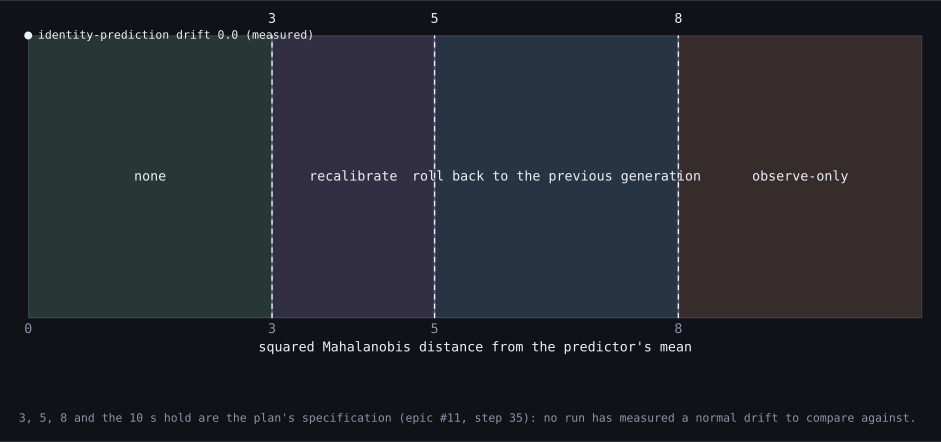
The ladder's escalation as four bands, separated at the plan's 3, 5 and 8 and labelled with the
step each selects; the measured identity-prediction drift (0.0) is marked on the axis.
The chart says on its face that the thresholds are a specification, not a measurement.
What the rules say, in order
default_rules() returns, in this order:
MissionClosed { outcome: "failed" } → LowerCoupling { factor: 0.90 }PromotionRolledBack → EnterObserveOnlyQuarantined → RequestTraining— a quarantine is a reason to learn from what survivedDriftAbove { threshold: 3.0 } → EnterObserveOnly
Rules are data, so a later rule set is a new vector and not a code change. What is measured about them is their order and their effect on the events the braid can receive: the seven tests cover the table, and the board re-ran the whole crate at 24 passed.
Evidence
| Quantity | Value | Unit | Source |
|---|---|---|---|
| Identity-prediction drift | 0.0 | squared Mahalanobis | drift_is_zero_for_identity_prediction |
| Mute pair for a bad sample | 0.0 / 0 |
distance / samples | mismatched_sample_is_no_opinion |
| Drift tests, host | 3 passed / 0 failed | tests | T34 comment ^1 |
| Drift tests, Pinkie aarch64 | 6 passed / 0 failed | tests | Board3 comment, PR #195 ^2 |
qualia-braid on Pinkie (T34) |
17 passed / 0 failed | tests | same ^2 |
qualia-braid on Pinkie (T33) |
24 passed / 0 failed | tests | Board3 comment, PR #200 ^2 |
| Coupling factor on failure | 0.90 | factor | crates/braid/src/rules.rs |
| Drift rule threshold | 3.0 | squared Mahalanobis | crates/braid/src/rules.rs |
| Files compared by the provenance gate | 152 authored, 0 identical | files | T34 comment ^1 |
| Ladder thresholds 3 / 5 / 8, hold 10 | — | squared Mahalanobis, s | epic Step 35 text ^3 |
^1 Host tests on the dev workstation in a different session from the board runs.
^2 Pinkie, native aarch64, from a git archive of the head; qualia-braid has no binary, so
cargo test -p qualia-braid is its own smoke path.
^3 The 3, 5, 8 and 10 s values are the plan’s specification, not measured behaviour. No code in the
tree compares a drift to them.
The commit range this entry describes is 7cac730..7b3bd15 — the drift commit through the merge of
T34. The rule layer landed in 2891580 (PR #200, 2602c4d, merged 2026-09-11T19:25:47Z). This
entry’s epic is
EPIC-08C (#11); tickets
T33 #49 and
T34 #50.
What this does not establish
- The ladder has not landed. As of 2026-09-11T20:45Z,
crates/braid/src/heal.rswas not inmain; T35 (#51) wasstatus:claimed, with the ladder on PR #209 (ticket/T35, headd8b05af, open), and T36 (#52, the authority bound on safe stop) was stillstatus:ready. So no step has been selected from a real drift, no rollback has been requested, and no safe stop has been requested. - The drift thresholds are uncalibrated. 3, 5 and 8 are the plan’s numbers. No run has measured what a normal drift looks like on this stack, so there is no evidence that these values separate “fine” from “recalibrate”.
DriftAbovefires on nothing. As above: the braid carries no drift event, so the fourth default rule is inert until the wire does.measurehas no board capture. Step 47 lists T35 as one of three mandatoryneeds:profilecaptures — the ladder’s decision path as a CPU timeline, with no kernel in it — and that capture cannot exist until the decision path does.- Drift is a number, not a diagnosis. A large squared Mahalanobis says the latent is far from the predicted mean under the predicted precision; it does not say whether the model is wrong, the world changed, or the precision estimate is bad. The ladder is a policy over that number, and the policy is untested.