Journal / 11 September 2026
The fly in the belief matrices
A connectome prior loaded, digest-checked, coupled into the belief layers behind an off-by-default feature, and watching its own rate model publish observe-only — seven tickets, a 1.75 coupling total on the 4090, and three CUDA kernels measured at 2.50, 10.59 and 11.84 µs.
The claim. The prior is now a number in the belief loop and a number on the GPU, and neither
number can move a motor. CouplingPrior::load verifies the producer’s three section digests — and the
size the counts imply — before it decodes anything; couple scales each mapped belief slot by its
type’s in-strength — the summed weight of that type’s incoming edges — normalised by the peak, and
returns the total applied. On the 4090, with a fixture whose in-strengths are 4, 8 and 2, that total
printed fly prior: applied 1.75 once per tick (0.5 + 1.0 + 0.25), 162 lines in about 5 s — and
the arithmetic is normalised, so the value is a weight, not a count. Behind it: the flag fly-prior, off by default, under which both backends
return Ok(0.0) for every input; an invented rate model in a separate crate behind a second
off-by-default feature; and three new kernels measured on the 4090 at 2.50 µs (belief_couple,
1 × 4), 10.59 µs (action_score, 2 × 256) and 11.84 µs (perception_voxel, 48 × 256).
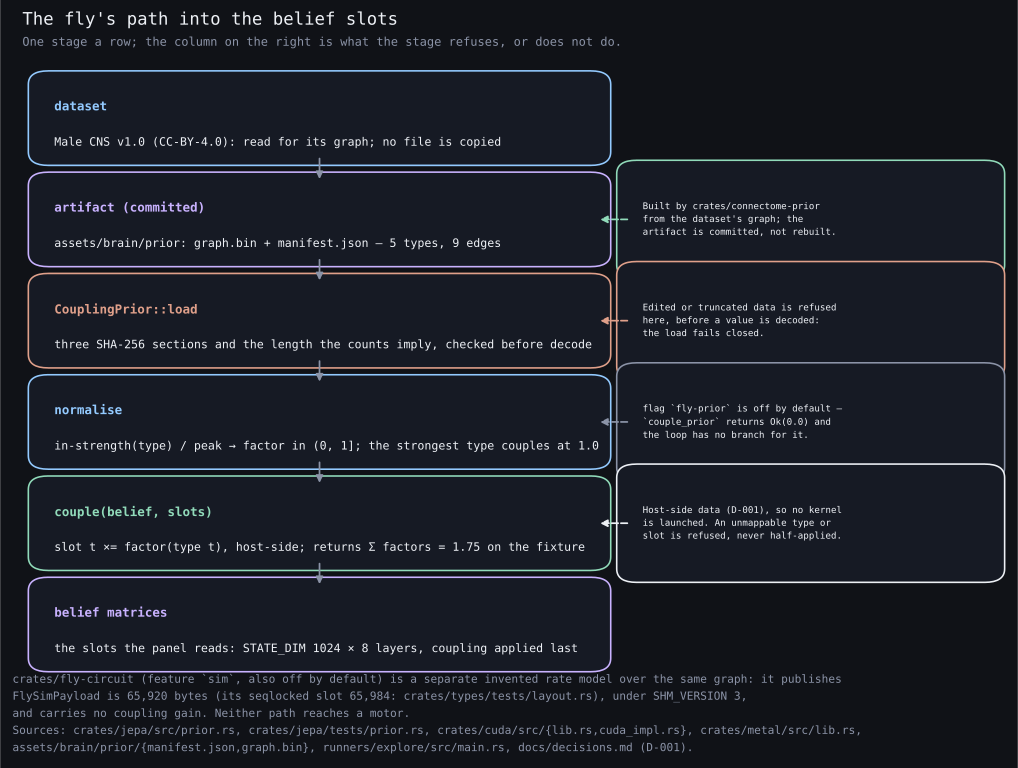
The connectome artifact's path into the belief slots: dataset → committed
graph.bin/manifest.json → digest-checked load → peak-normalised
in-strength → couple(belief, slots) → the layer belief, with the off-by-default
fly-prior flag, the refusal on an unmappable mapping, and the coupling's host-side
(no-kernel) nature called out.
What we tried
A signature that could not work on one of the two backends was changed, and said so. The plan’s
step 11 gives Metal the same couple_prior(ctx, prior, slots). MetalContext is macOS-only, the
coupling is host-side data (D-001), and the Metal belief loop holds no MetalCognitionStack — building
one to pass it here would allocate and initialise the whole layer set for a host-side sum. The shipped
Metal signature is couple_prior(prior, slots), same name, same feature, no context.
The per-tick call moved out of the runner. Step 12 puts couple_prior in each belief runner’s
src/main.rs; those are pure dispatchers, and runners/l3-belief’s own test pins that the runner must
not touch the layer slot. The mode, the prior load and the diagnostics stay in the runners; the
per-tick coupling is wired where the loop is, in the compute backends, behind the same feature. The
reference tree has no QUALIA_FLY_* and no coupling, so no reference behaviour could decide this; the
plan’s intent — a per-tick coupled belief under QUALIA_FLY_MODE — could not be reached from a
dispatcher.
A stacked PR stranded a ticket, and it was replayed rather than re-invented. #27 (T12) was
opened with base ticket/T11 and merged into that branch; when ticket/T11 was later rebased onto
main, the rebase dropped the merge commit and with it T12’s commits, so the work was an ancestor of
neither. That is now decision D-019, and the replay (ticket/T12-replay, PR #198) is a single
cherry-pick -x of the reviewed commit. It was open when this entry was written and merged on
2026-09-11T19:55:37Z in 14b60de (PR #198).
The simulator was kept away from the motor path by construction. The dataset carries no dynamics
and no sign; the model is invented. So it is a separate crate (qualia-fly-circuit, feature sim
off by default) whose README says in one paragraph that it is a rate model over a graph, not a
connectome simulation; its weights are used as positive because the artifact carries no sign; and a
build without the feature compiles an empty crate with no dependencies.
Coupling is a normalisation, and the observable is the total
\[\text{applied} \;=\; \sum_{i \in \text{slots}} \frac{\text{strength}(type_i)}{\max_j \text{strength}(type_j)}\]Two consequences are worth separating. First, the value is bounded by the slot count and reaches 1.0
only for a uniformly innervated graph — the same property that later made a naive “sum, then clamp to
0..1” reading a de-facto boolean, so the exploration ticket divides by the coupled-type count (the
mean applied weight) instead. Second, the prior cannot silently half-apply: a mapping the graph or
the layer cannot satisfy is refused with UnknownType(u32) or SlotOutOfRange(usize), not skipped,
so a stale mapping cannot read as a partial success. With the feature off, the symbol exists and
returns Ok(0.0); there is no branch in the belief loop.
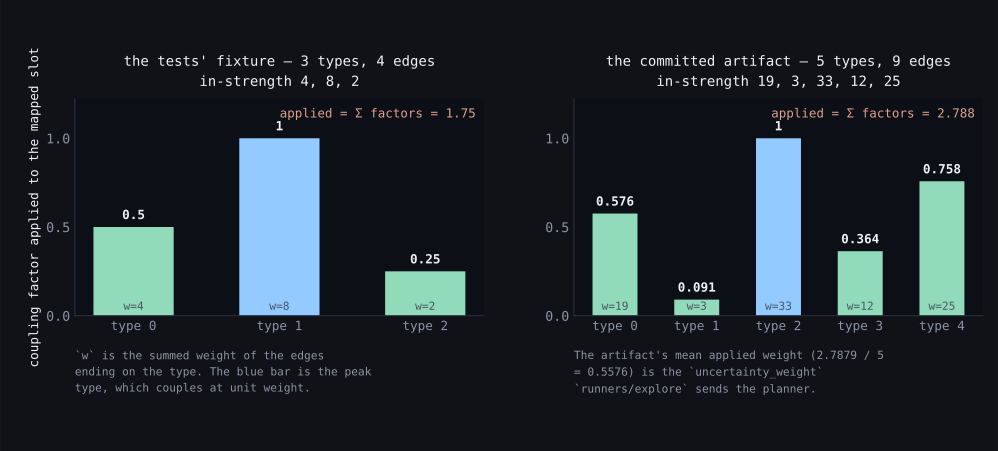
The factor CouplingPrior::couple applies to a mapped belief slot, per type:
left, the tests' three-type fixture (in-strength 4, 8, 2 → 0.5, 1.0, 0.25, applied 1.75);
right, the committed five-type artifact (in-strength 19, 3, 33, 12, 25, peak 33, applied
2.7879, mean 0.5576). The blue bar is the peak type, which couples at unit weight.
The honest limit, recorded on the ticket: on an idle stack the coupling’s effect on the published belief is not separately observable — the belief starts at zero and the identity model keeps it there, and the coupling scales the mean. The observable is the per-tick total above plus the unit test that pins the normalised scaling.
The board and the GPU
Two independent exercises, and they measured different things.
The Orin NX (aarch64). qualia-cuda --features fly-prior → 29 passed / 0 failed, including
coupling_applies_the_prior_by_type_strength and coupling_refuses_an_unmappable_slot;
qualia-metal --features fly-prior → 15 passed (the platform-independent CPU fallback; no Metal
device is claimed on Linux). The coupling tests opened a real CudaContext — no skipping line — and
the artifact was an ELF aarch64 binary. The FlySimSlot half landed separately on the board:
qualia-jepa-runtime --features sim → 8 passed plus 2 smoke tests, with
fly_sim_publishes_only_while_observe_only_is_approved publishing sim_step 1 then 2 into
SHM_VERSION 3’s slot, and a smoke start that printed fly sim: disabled (QUALIA_FLY_PRIOR_PATH is
unset).
The 4090. The three new kernels ran once each in a single-threaded capture under Nsight Systems
(WSL2 host, nsys 2025.3.2.474, mage 0.1.0): 16 launches over 8 kernels, 4892.89 µs of kernel
time, of which the new three are 2.50 µs (belief_couple), 10.59 µs (action_score) and 11.84 µs
(perception_voxel). That capture is committed under docs/evidence/T16/three-kernels/ and is the
number T17 and T18 have to beat. It replaced a 5-kernel baseline of 4784.75 µs / 13 launches
(docs/evidence/baseline-2026-09-11/, at 76143f0).
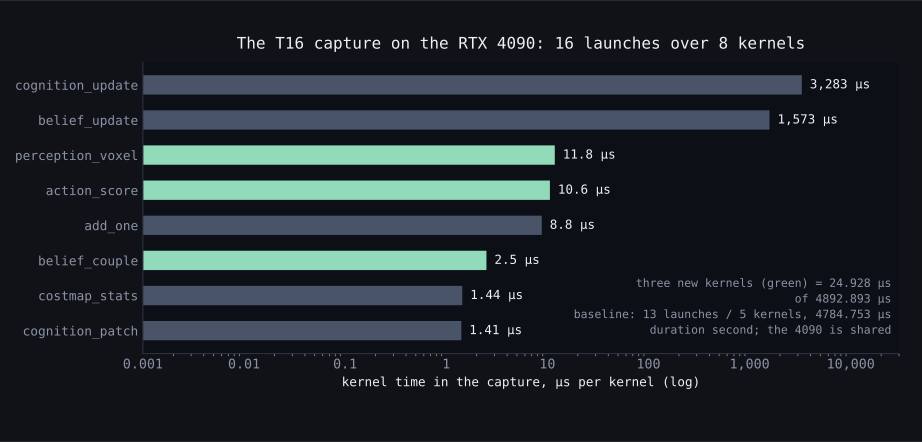
The T16 capture's per-kernel time on the RTX 4090 (log axis): 16 launches over 8 kernels,
4892.893 µs, of which the three kernels this epic added (belief_couple 2.50,
action_score 10.59, perception_voxel 11.84 µs) are 24.928 µs, against
the 13-launch, 4784.753 µs baseline they replaced.
The ABI for the simulator’s slot is fully pinned: FlySimPayload is repr(C, align(64)), 65,984
bytes, with a 65,536-byte state array (FLY_SIM_MAX_TYPES = 16,384 f32) and SHM_VERSION bumped
2 → 3. The payload carries no coupling gain — the model keeps gain private, so an observer cannot
be handed a value the writer cannot read.
Evidence
| Quantity | Value | Unit | Source |
|---|---|---|---|
| Fixture coupling total per tick | 1.75 | weight | T12 comment (RTX 4090 smoke) ^1 |
| Fixture in-strengths | 4, 8, 2 (peak 8) | weight | T12 comment ^1 |
cuda fly-prior tests on Pinkie |
29 passed / 0 failed | tests | Board3 comment, PR #190 |
metal fly-prior tests on Pinkie |
15 passed / 0 failed | tests | same |
jepa-runtime sim tests on Pinkie |
8 + 2 passed | tests | Board3 comment, PR #189 |
FlySimPayload size |
65,984 | bytes | T15 ABI table |
FLY_SIM_MAX_TYPES |
16,384 | types | T15 ABI table |
SHM_VERSION after T15 |
3 | version | T15 comment |
belief_couple on 4090 |
2.50 | µs/launch | docs/evidence/T16/three-kernels/README.md ^2 |
action_score on 4090 |
10.59 | µs/launch | same ^2 |
perception_voxel on 4090 |
11.84 | µs/launch | same ^2 |
| Capture total (8 kernels) | 4892.89 | µs | same ^2 |
| Prior capture total (5 kernels) | 4784.75 | µs | docs/evidence/baseline-2026-09-11/README.md ^2 |
^1 Measured on the host’s RTX 4090 in a different session from the board runs; the value is the
fixture prior’s total, not a dataset-scale coupling.
^2 Both captures are from different sessions and different hardware: the T16 capture is the RTX 4090
under nsys on WSL2; the baseline is the same host before the three kernels existed. Durations on a
shared 4090 are one contended sample; launch count and shape are the stable part.
The commit range this entry describes is 5999ba4..b13ca80 — the first coupling commit through the
merge that put the backend couple_prior on main. Epics:
EPIC-04 (#4),
EPIC-05 (#5),
EPIC-06 (#6).
What this does not establish
- T17 has not landed; T18 landed after this entry’s period. CPU/CUDA parity for the three new
kernels was
status:ready(#32) and wasstatus:reviewas of 2026-09-11T20:45Z (#32, open): the three kernels have host oracles and a capture, not a parity assertion. The ≤ 6 GiB memory plan and thesm_87/sm_89fatbin targets werestatus:ready(#33); T18 landed in60beee4(PR #207, merged 2026-09-11T20:16:14Z), and its board capture shows the sm_87 cubins loading on Pinkie with noCUDA_ERROR_UNSUPPORTED_PTX_VERSION(docs/evidence/T18/fatbin-sm-87/). - T12 was not on
mainwhen this entry was written. The runner wiring that readsQUALIA_FLY_MODEand loads the prior at start-up was the replay on PR #198, then still open; it merged in14b60de(2026-09-11T19:55:37Z). At the entry’s endpoint,maincarried the backend coupling, the manifests’ env keys and the tests. semantic_noveltyand dimorphism are not derivable. The artifact aggregates dimorphism away and the runtime carries no cell-to-type map; the exploration ticket sends a documented0.0.- The simulator has no drive. Nothing in the JEPA path is an input to the type graph, so the published state is the model’s resting state with a zeros drive — stated in the code, not hidden.
couple’s effect on published belief is unobserved on an idle stack (see above). The per-tick total and the unit tests are the evidence; a mission that moves the belief has not been run.- The 4090 numbers are one contended session. No error bar and no repeated-run spread are recorded in the T16 capture; compare shape and launch count first.