Journal / 11 September 2026
The agent in the loop
A braid that stores nothing, a write edge invented because two strands are separate processes, a belief clock that lets the map degrade instead of stopping, and an exploration mission that opens itself — with an uncertainty weight of 0.625 measured on the robot.
The claim. The agent now has one place where strands report and one view they report into. A
strand is one part of the stack that reports events into that state — at this edge, three owners: the
mission broker, the evidence recorder and the JEPA runtime; the crate’s vocabulary is one variant
wider, recovery’s Quarantined being a dispatch rather than a strand report — and the braid is the
state itself: a state machine plus a dispatch that stores nothing, since the durable copies stay
in MCAP, SQLite and the registry and observe is the only mutator. Two of the three strands are
separate processes and cannot call it in the agent’s address space, so the ticket grew a write edge:
POST /braid carrying the frozen BraidEvent envelope, beside the read GET /braid. The board
accepted it: with the TLS surface up, POST /braid mission_opened returned HTTP 200 and the
follow-up read showed open_missions 0 → 1; GET /braid answers
{"schema_version":"qualia.braid-state.v1", …}. On the same board, qualia-agent finished at
41 passed / 0 failed. And the fly is in the loop quantitatively: at stack start the runner opens
explore-frontier and sends fly prior: risk uncertainty_weight=0.625 semantic_novelty=0.
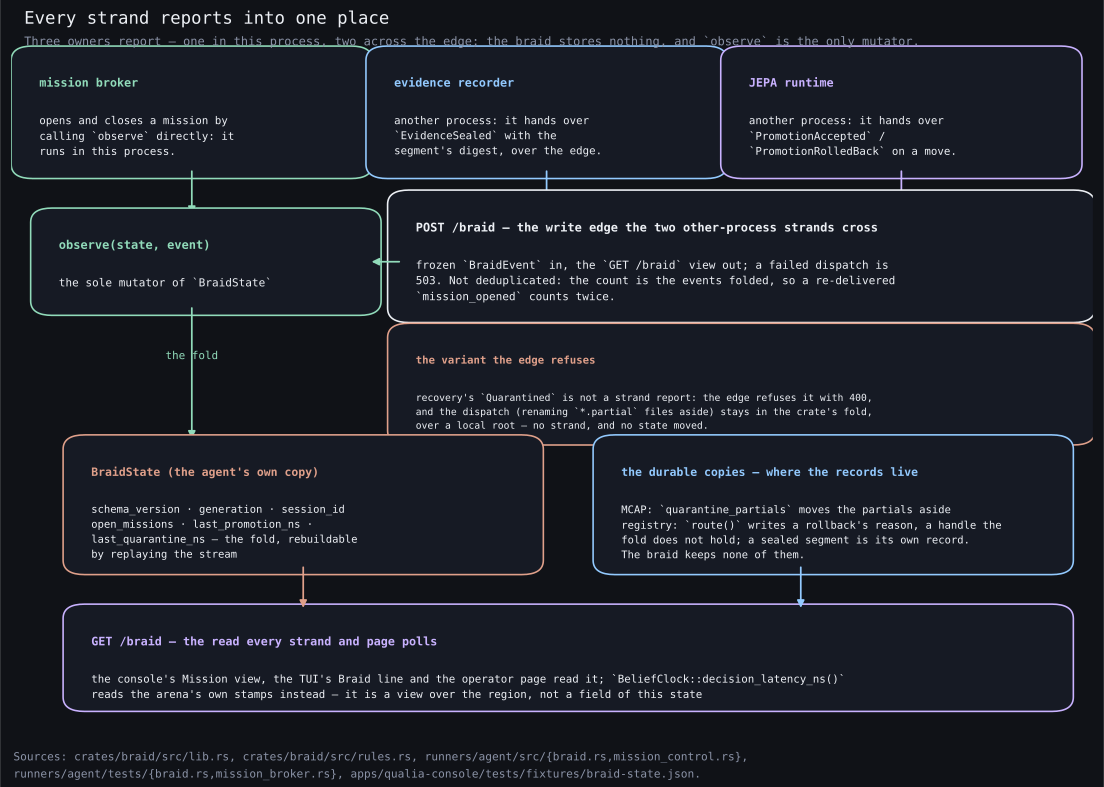
The strands reporting into observe through the one write edge —
POST /braid carrying the frozen BraidEvent (503 on a failed dispatch, a
quarantined report refused with 400) — then observe as the sole
mutator, the folded BraidState and its six fields, the durable copies the braid
keeps none of, and the GET /braid read the console, TUI and operator page poll.
What we tried
The rollback dispatch was deferred, with a failing test to prove it. Step 19 says observe calls
the registry’s existing rollback. The fixed interface,
observe(state: &mut BraidState, event: &BraidEvent), is synchronous and carries a
PromotionRolledBack { generation, reason } with no registry handle and no generation-pointer path;
the registry itself had only a [[bin]] target and a fn main() {} at the time, so
cargo tree -p qualia-braid warned about a dependency with no lib target. Rather than change the
interface the ticket fixes, T19 keeps the state transition (the generation moves, last_promotion_ns
does not) and the reason stays on the wire, asserted by a test that decodes the envelope. The call
moves to C10 (#76) and the routing to T22 (#37). A temporary test asserting the braid records the
reason was written first, failed as expected, and was removed; the committed assertion is the one that
stays true.
The braid’s event vocabulary resisted invention. T19 added one variant, Unknown, marked
#[serde(other)], so a future event decodes and leaves the state untouched — the forward-compatibility
arm the epic’s own test asks for.
The read-only write edge. The literal step — every strand calls observe itself — is impossible
for arena-recorder and jepa-runtime, which are processes. Main ruled the write edge into the
ticket: body is crates/braid’s frozen envelope, reply is the view GET /braid returns, a failed
dispatch is 503, and AuthScope::Peer (already loopback-bypassed) means co-located runners need no
new secret. The agent’s src/braid.rs dropped its local mirror of the braid types and now holds the
one BraidState the process owns.
Board hygiene was found the hard way. Two later suites died with SIGBUS because the board’s
/dev/shm was 100 % full — 33 stale 64 MiB qualia* test regions, about 1.8 GB, owned by no live
process. After rm -f /dev/shm/qualia* (100 % → 1 %) the same commands were green. It is reported in
the board comment and every later board leg checks df -h /dev/shm first. A parallel test-isolation
defect (ShmError::OsError(17) from two smoke tests naming one region) was fixed with a per-test
region name and re-run green.
Pacing: the map degrades, it does not stop
QUALIA_BELIEF_PACE_MS (default 250) gates runners/map and runners/pose: before publishing,
wait until the newest accepted belief commit is younger than the window; if none has been committed
for 8× the window, publish anyway and log
belief pace: stale, publishing map/pose at {lag} ms. A live probe of the real qualia-pose binary
with a belief tick 300 ms old and QUALIA_BELIEF_PACE_MS=200 held the first pose for 1.3 s, then
logged qualia-pose: belief pace: stale, publishing pose at 1604 ms (a second run read 1605 ms). That
is the design in one line: navigation slows, it does not deadlock. Nothing in the step writes to the
ROS graph; leash remains the mapping/localization provider boundary.
The other half of Step 24b is the clock. BeliefClock::decision_latency_ns() reads the newest
BeliefSlot timestamp across the eight layers, subtracts the newest finished ledger row, and returns
zero when either side is absent or when a ledger row reads newer than the belief — zero rather than a
wrapped subtraction. It sits on an arena view, not on BraidState, because the braid’s state is
serialised to JSON at GET /braid and holds no mapping. T27’s TUI renders it as
belief lag: {ms} ms.
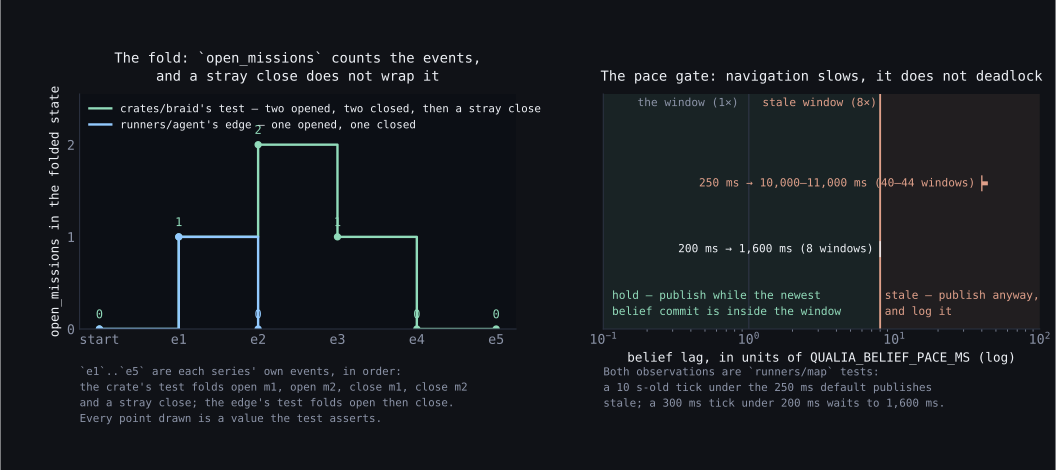
The lifecycle and the gate: left, open_missions through the fold (1, 2, 1, 0, 0 —
including a close for a mission it never saw) and the write edge's (1, 0); right, the belief pace
gate — the window (1×), the stale window (8×), the hold region, and the two stale publications
runners/map's tests assert (a 10 s-old tick under the 250 ms default; a 300 ms-old
tick released at 200 × 8 = 1,600 ms).
The exploration mission, and one field that could not be computed
runners/explore now opens MissionOpened { mission_id: "explore-frontier" } at stack start and puts
the fly prior into the planner request’s existing belief_risk block. uncertainty_weight is the
prior’s total applied weight divided by the number of coupled types — the mean applied weight per
type. The raw total was tried first and rejected by review: couple sums peak-normalised strengths,
the peak type is always among them, so the sum is always ≥ 1 and the clamp to 0.0..=1.0 made the
field a de-facto boolean. The mean is inside the range by construction and reads 0.625 on the board.
semantic_novelty could not be computed at all: the artifact aggregates dimorphism away and the
tree has no cell-to-type map, so it is a documented 0.0, and the ticket records the two shapes (a
male_specific mask section in the artifact, or a typed sidecar) that would make it real.
Evidence
| Quantity | Value | Unit | Source |
|---|---|---|---|
POST /braid reply |
200, open_missions 0 → 1 |
— | Board3 comment, PR #196 ^1 |
qualia-agent on Pinkie |
41 passed / 0 failed | tests | same ^1 |
qualia-arena-recorder on Pinkie |
14 passed / 0 failed | tests | same ^1 |
qualia-jepa-runtime on Pinkie |
9 passed / 0 failed | tests | same ^1 |
| Stale belief regions before clearing | 33 × 64 MiB (~1.8 GB) | regions | same ^1 |
| Belief pace default | 250 | ms | QUALIA_BELIEF_PACE_MS, T21 |
| Stale window | 8 × the pace | — | T21 comment |
| Held first pose in the probe | 1.3 | s | T21/T24b comments ^2 |
| Stale log lag | 1604 (and 1605) | ms | same ^2 |
| Map tests | 14 unit + 4 e2e | tests | T21 comment |
| Pose tests | 25 unit + 3 e2e | tests | ResumeT21 comment |
uncertainty_weight on Pinkie |
0.625 | — | Board1 comment, PR #184 ^1 |
explore tests on Pinkie (after fix) |
18 passed / 0 failed | tests | Board2 comment, PR #184 ^1 |
| Braid tests on Pinkie (T24b) | 6 + 4 + 1 passed | tests | T24b comment ^1 |
^1 Board runs on Pinkie, native aarch64, from a git archive of the head; taken in a different
session from the host work in the same ticket.
^2 The 1.3 s hold and the 1604/1605 ms stale line are from two bounded live probes of the real
qualia-pose binary, in sessions different from the board runs; the pose runner’s own timing, not a
board measurement.
The commit range this entry describes is bf4c506..f39c114 — the braid state machine through the
merge that landed the exploration mission. Epics:
EPIC-07 (#7),
EPIC-08 (#8),
EPIC-08B (#9).
What this does not establish
- The self-improvement loop has not landed. As of 2026-09-11T20:45Z, EPIC-08B owed all three
parts: the bounded
QUALIA_FLY_COUPLING_SCALEdial (#46,status:claimed), closing the training/promotion loop through the braid (#47,status:claimed) and its failure paths (#48,status:ready). No coupling scale has been clamps-tested, no training job has been submitted by an agent, and nothing has been promoted. - T20’s PR merged after this entry’s board leg. The
POST /braidwrite edge and the strand reports are on PR #196, merged 2026-09-11T19:25:44Z in9fd1e69; the board exercised the head. T22 (#37, rollback and quarantine routing) wasstatus:readywhen this entry was written and has since landed too (5c304dc, PR #204, merged 2026-09-11T20:06:32Z;#37closed,status:review). - The sync-types
fly_governedfield defaults false and has never been true at runtime. It landed with the C04 rewrite (3b4fa66), and the test asserts the default and a round trip, not a mission that set it. - The pace probe was one binary in one window.
mapandposehave unit and end-to-end tests, and the launch-time stale behaviour was observed once at 1.3 s; no multi-minute soak was run. open_missionsis a counter, not a mission. Nothing on the board drove an actual exploration to completion; the round trip proves the edge, not the behaviour.- The board was shared. Other agents were building and running on Pinkie during these legs; the reported results are agreements across runs, not undisturbed measurements.